Método PONS
The architecture of performance: PONS institutional methodology
Institutionalize performance in your club with the PONS decision architecture methodology.
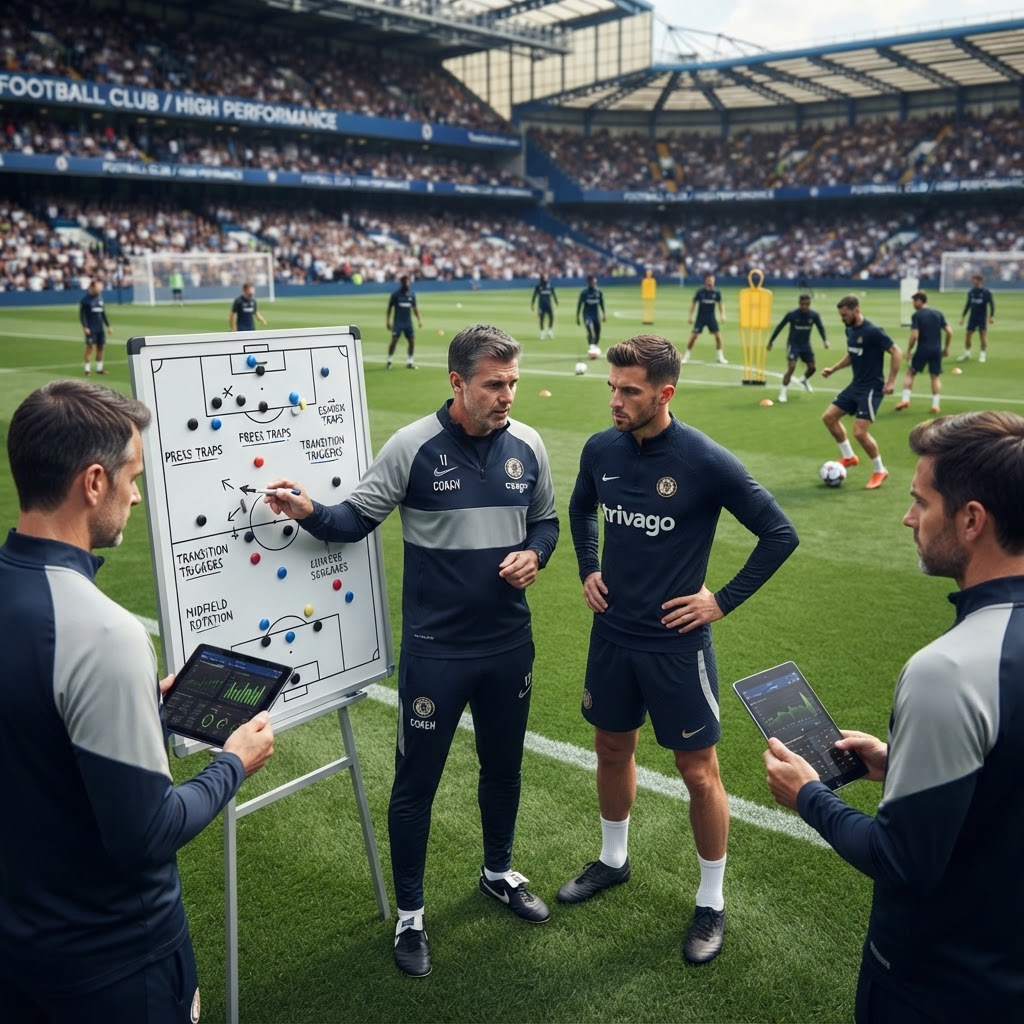
This idea illustrates the difference between having football concepts and possessing a methodology capable of structuring how they are learned, applied, and verified. In elite football, the difference between a predictable team and one capable of dominating the context does not reside in the accumulation of tactical mechanisms, but in the solidity of its decision architecture. Many clubs fail by confusing the sophistication of their training drills with the actual responsiveness of their players to uncertainty. True competitive excellence emerges when the staff manages to integrate a network of shared references that allow the footballer to make autonomous and precise decisions in milliseconds. The thesis is clear: tactics are a convention, but methodology is the structure that supports that convention under the stress of competition. Without a common reference system, individual talent is diluted into a noise of disconnected actions. To institutionalize this performance, the staff must abandon the role of movement choreographer and adopt that of system architect, where training is not measured by the beauty of the executions, but by the actual transfer to the decision window during the match. The practical implication is stark: before designing a task, define the cognitive constraint that will force the player to process information under pressure. If the task does not require a choice between viable options, it is simple choreography, not elite training. The high-performance structure requires a common language that transforms the complexity of the game into a flow of coherent operations, regardless of the score or the opponent. Visually, this architecture can be represented as a topographic map superimposed on a playing field, where the lines of force are not ball trajectories, but illuminated decision nodes that activate according to the team's position and intent. This invisible layer is what separates seasonal clubs from those that build a sustainable legacy through their methodology. The PONS Method turns the principle into an architecture of relationships, decisions, and transfer instead of leaving it as an isolated statement.
Explore David Pons professional profile and strategic collaboration