MÉTODO PONS · WEEKLY NEWSLETTER →PROPOSE COLLABORATION →

Método PONS

The Architecture of Performance: Training and Decision-Making

The architecture of performance is friction: training for decision-makers.
The Architecture of Performance: Training and Decision-Making
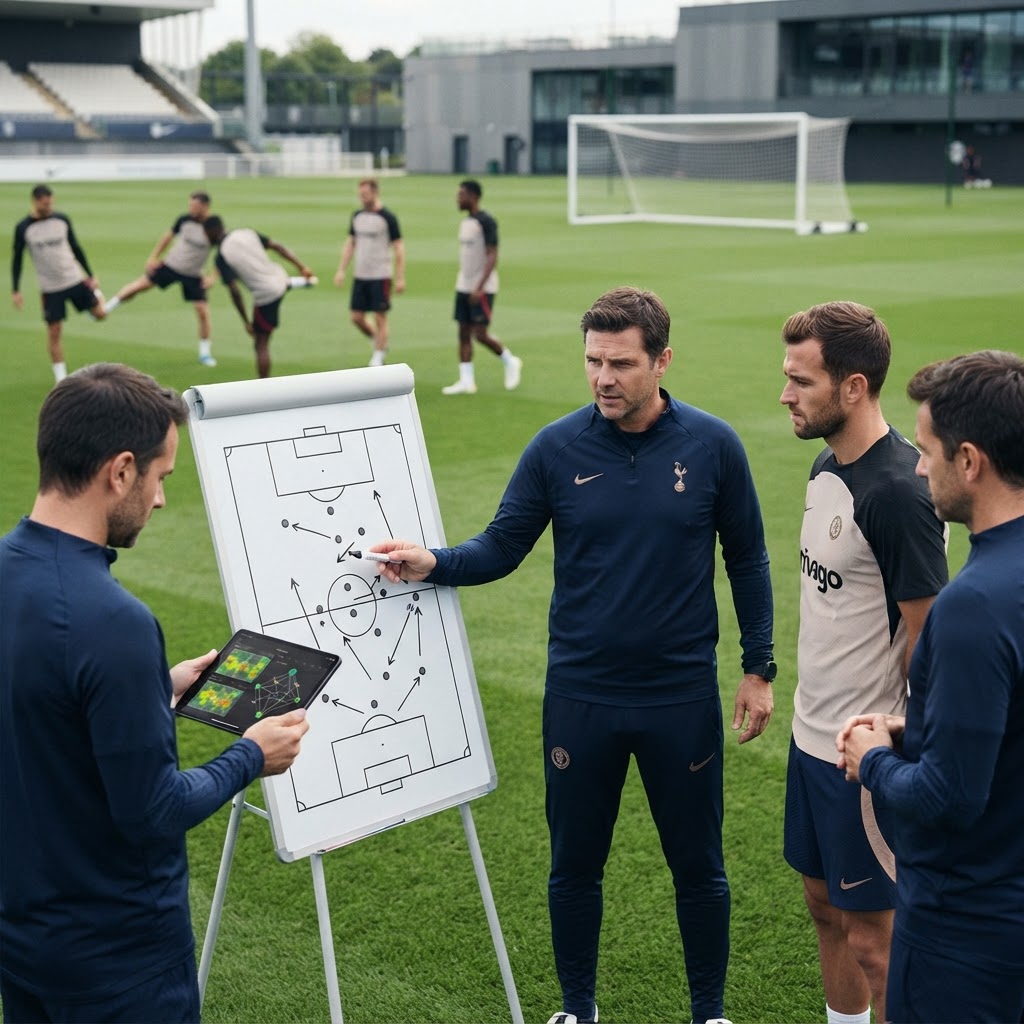
This idea illustrates the difference between having football concepts and possessing a methodology capable of structuring how they are learned, applied, and verified. The central thesis of modern football often falls into a dangerous trap: believing that technical repetition in sterile environments generates tactical competence in competitive environments. The methodological error lies in assuming a linear transfer where isolated exercise adds up to collective performance. However, football is not an accumulation of gestures, but a dynamic system of interdependent decision-making. When we isolate a pass, a touch, or cover, we eliminate the critical variable: the context of uncertainty that dictates the value of the gesture. The true architecture of training does not lie in the sum of tasks, but in the quality of the cognitive friction to which the player is subjected. If the footballer does not face 'structured chaos'—where perception and action overlap under constant pressure—training becomes an aesthetic choreography without competitive impact. Performance does not improve through the quantity of repetitions of a movement, but through the complexity of the dilemmas the athlete must resolve for that movement to make sense. The practical implication for any sports organization is clear: we must stop measuring progress by work volume and start evaluating it by the transfer rate of decisions. The PONS Method turns the principle into an architecture of relationships, decisions, and transfer instead of leaving it as an isolated statement.

Continue learning through the most relevant PONS route

Continue with the relevant PONS learning route

#PonsMethod #PerformanceArchitecture #SystemicFootball #Development #PONSMethod #FootballMethodology #HighPerformance #FootballCoaching #Methodology #Football
Request implementation of the method. The central thesis of modern football often falls into a dangerous trap: believing that technical repetition in sterile environments generates tactical competence in competitive environments. The methodological error lies in assuming a linear transfer where isolated exercise adds up to collective performance. However, football is not an accumulation of gestures, but a dynamic system of interdependent decision-making. When we isolate a pass, a touch, or cover, we eliminate the critical variable: the context of uncertainty that dictates the value of the gesture. The true architecture of training does not lie in the sum of tasks, but in the quality of the cognitive friction to which the player is subjected. If the footballer does not face 'structured chaos'—where perception and action overlap under constant pressure—training becomes an aesthetic choreography without competitive impact. Performance does not improve through the quantity of repetitions of a movement, but through the complexity of the dilemmas the athlete must resolve for that movement to make sense. The practical implication for any sports organization is clear: we must stop measuring progress by work volume and start evaluating it by the transfer rate of decisions. An effective training design is one that, before asking for a pass, demands a reading of the environment. The player must be exposed to problems that do not have a single, predefined solution. The architecture of success is not built with players who execute orders, but with decision-makers who understand the grammar of the game. The goal is not the automation of the gesture, but the optimization of the cognitive response. Visual concept: A split image. On the left, a player making a pass on an empty field with cones and geometric lines marked in red (representing linearity). On the right, the same player in a high-density field, blurred passing lanes and multiple pressure vectors, visualizing a neural network activating in their brain (representing systemic complexity). https://institutometodopons.com | https://football.ponsmethod.com | https://ponsmethod.com